
When a Car Burns and Children Flee: Four Minors Arrested After Theft and Accident in Esporles
When a Car Burns and Children Flee: Four Minors Arrested After Theft and Accident in Esporles
A car stolen in Palma crashed in Esporles and burned out. Four youths (15–17) were arrested and handed over to the juvenile public prosecutor. A reality check: What does this event reveal about prevention, upbringing and police work on the ground?
When a Car Burns and Children Flee: Four Minors Arrested After Theft and Accident in Esporles
Key question: What does this incident reveal about the gaps in prevention and youth support on Mallorca?
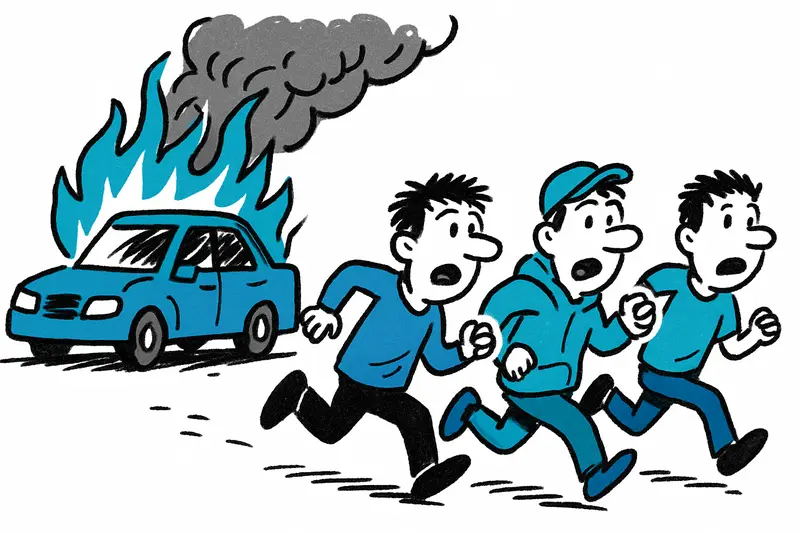
On the evening of 21 February, Guardia Civil units discovered a completely burned-out vehicle near the settlement of Ses Rotgetes de Canet in the municipality of Esporles. Investigations showed that the car had been stolen in Palma hours earlier. Four youths aged 15 to 17 were identified as suspected perpetrators a few days later and were arrested on 24 February. The youths were handed over to the juvenile public prosecutor in Palma (see three juveniles arrested); the material damage is estimated at more than €27,000.
Critical analysis: At first glance, this is a classic sequence: theft, flight, accident and a car in flames. But behind it lie several problem areas at once. First the obvious: how is it possible that young people gain access to a vehicle so quickly and then embark on such a risky drive? It is not only about the act itself but about the circumstances — neglected leisure structures, lack of prospects, dares within peer groups or simply insufficient vehicle security in Palma.
The individuals left the scene before the police arrived, a dynamic seen in other incidents such as the Fatal crash at Son Castelló. That not only removes potential witnesses but also makes it harder to clarify responsibility. The Guardia Civil established the sequence of events; the investigation took only a few days until identification and arrest. That speaks to effective police work — yet quickly locating and securing traces in cases of fire remains a constant challenge, especially when the scene is in a rural area.
What is missing from public discourse: the incident is often labelled simply as “youth crime.” That is an overly simplistic category. No one talks enough about the preconditions: what are the local leisure offerings? Are there accessible youth centers, functioning school social work or youth workers? What is the family structure like, what about supervision and neighborhood networks? And last but not least: what role do digital communication platforms play, where dares and meeting points are organised?
Everyday scene from Mallorca: anyone walking in Ses Rotgetes de Canet knows the dense pine forests, the smell of burnt resin and the occasional dog barking on a terrace. On a cool evening you hear the distant roar of the MA-11 and the crunching of gravel on access roads. It was in such a quiet landscape that suddenly a bright light appeared, smoke rose and a car was nothing but a glowing shell — a scene that unsettles residents and prompts conversations at front doors: "Who are the kids?", "Why did it end like this?".
Concrete solutions: prevention before repression. That does not mean weakening police work, but complementing it: 1) More visible youth offerings in Palma and in the villages; mobile leisure buses, evening programmes in municipalities like Esporles (see Spotlight on Son Castelló) to create supervised meeting points. 2) Vehicle prevention programmes: awareness campaigns for young drivers and parents about theft protection and the consequences of risky driving. 3) Cooperation between schools, youth services and the Guardia Civil: early intervention, mediation and mandatory educational sessions instead of purely criminal sanctions. 4) Technical measures: subsidised theft protections for older vehicles and information campaigns about simple protective measures.
Another component is the consistent use of juvenile law options: the juvenile public prosecutor can not only respond criminally but also press for measures of reparation and social support — for example community service, supervised courses on traffic risks or psychological support for at-risk youths. Such steps are often more effective than fines or isolation alone.
No one on Mallorca likes to see young people commit crimes. It is bitter for the victims — in this case the owner of the vehicle — and for the community. At the same time, it is worth not stopping at indignation. A burning car at the edge of a village shows that questions of safety, prevention gaps and the task of upbringing come together. Those who rely only on harsher punishments overlook that a return to normality for those affected can only succeed with support.
In conclusion: the incident in Esporles is not an isolated case of individual crime but a symptom. We need more concrete offers, clear rules and reliable contact persons where young people live and meet — and all of this before a dare turns into a destructive night. The police have done their part; society must now act.
Postscript: The facts remain unchanged — four minors (15–17), vehicle theft in Palma, accident and fire near Ses Rotgetes de Canet on 21 February, arrests on 24 February, handover to the juvenile public prosecutor, material damage of more than €27,000. Anyone who notices something in their neighbourhood should inform the authorities; prevention often begins with a neighbour's tip-off.
Read, researched, and newly interpreted for you: Source
Similar News
Should Mallorca Raise the Eco-Tax? A Reality Check After Barcelona's Shock Decision
Barcelona raises the overnight levy to up to 15 euros per night. In Mallorca there is cautious waiting. A critical look:...
Put on Ice: Why the Debate over Limits for Non-Local Cars in Mallorca Is More Than a Political Slowdown
The island council has postponed the bill to limit non-local vehicles. A political diversion that leaves questions open:...

Millions Disappeared in a House Purchase in Santa Ponça: A Reality Check
A former managing director admitted diverting around €3.5 million from the purchase of a villa in Santa Ponça. The court...
Death after fire: What the Escorca blaze reveals about our caution
A man dies after a fire in the Serra de Tramuntana near Escorca. Who protects the landscape and people when traditional ...
Live mishap on regional television: How could a caller break control of the broadcast?
A caller identifies as part of a niche community, insults the prime minister and exposes himself live on regional televi...
More to explore
Discover more interesting content

Experience Mallorca's Best Beaches and Coves with SUP and Snorkeling

Spanish Cooking Workshop in Mallorca
